WATSONIA MERIANA
Author:
Philip Miller, 1768
Family:
IRIDACEAE
Origin:
Elevation:
Publisher:
Gard. Dict. ed. 8.: n.° 1 (1768)
Collection number:
placeholder
Thickness:
3 Centimetres
Height:
50 Centimetres
Propagate:
Seeds/Corms
CITES:
Synonyms:
Antholyza meriana L., 1759.
And quite some; see below.
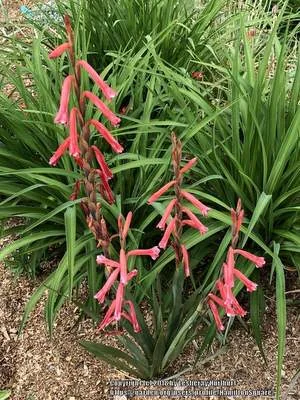
This member of the Iridaceae family was given this name by Philip Miller in 1768. It is found in southern South Africa, growing in a well drained soil with quite some water and lots of sun. The corm can grow to three centimetres in diameter, the entire plant to 50 centimetres in height, 200 with the flowers. The flowers are shades of orange to reddish or purplish. The genera is named after Sir William Watson, 1715–1787, a British physician and scientist who was born and died in London. His early work was in botany, and he helped to introduce the work of Carolus Linnaeus into England.
The species name mean 'belong to midday' for the flowers. This is a winter grower in the wild. Gladiolus amoenus, Salisb.1796. Gladiolus merianus, Thunb.,1784. Ixia meriana, Link, 1821. Antholyza fulgens Andrews,1801. Antholyza meriana var. minor L.,1767. Gladiolus infundibuliformis, Schrank, 1822. Gladiolus iridifolius, Jacq., 1791. Ixia iridifolia, Link, 1821. Neuberia pyramidalis Eckl., 1827. Watsonia bulbillifera J.W.Mathews & L.Bolus, 1922. Watsonia fulgens, Pers., 1805. Watsonia fulgida Salisb., 1812. Watsonia iridifolia, Ker Gawl., 1802. Watsonia iridifolia var. fulgens, Ker Gawl., 1802. Watsonia leipoldtii, L.Bolus, 1932. Watsonia meriana var. bulbillifera,, D.A.Cooke, 1998. Watsonia meriana var. iridifolia, Baker, 1877. Watsonia meriana var. platypetala, Baker, 1892. Watsonia vivipara, J.W.Mathews & L.Bolus, 1927. Watsonia wordsworthiana, J.W.Mathews & L.Bolus, 1925. The flowers by Trevor James, Weedbusters.org.nz. Wild plants, unfortunately in Australia from Publicdomainpictures.net. An invasive plant with exposed corm from Sydneyweeds.org.au.
Flower
Orange - Reddish - Purplish
Soil
Mix
Water
Medium - Maximum
Sun
Maximum
Similar plants