SQUAMELLARIA GUPPYANA
Author:
Guillaume Chomicki, 2016
Family:
RUBIACEAE
Origin:
Elevation:
Publisher:
PLoS ONE 11(3): e0151317 (20) (2016)
Collection number:
placeholder
Thickness:
15 Centimetres
Height:
80 Centimetres
Propagate:
Seeds
CITES:
Synonyms:
Hydnophytum guppyanum, Odoardo Beccari, 1885.
Hydnophytum hahlii, Rech.
Hydnophytum longipes, Merr. & L.M.Perry.
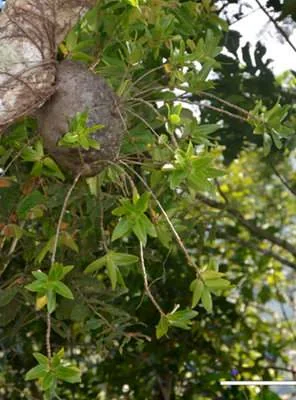
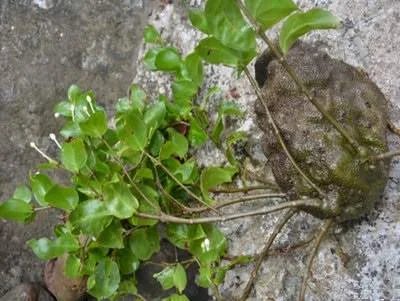
This member of the Rubiaceae family was given this name by Guillaume Chomicki in 2016. It is found in the Solomon Islands, growing as an epiphytic with some to lots of water water and some sun. The caudex can grow to fifteen centimetres in diameter, the entire plant to 80 centimetres in height. The flowers are white. The genera name refers to the presence of fringed scales, or squamellae, which are produced within the petals in some species. The species is named after Henry Brougham Guppy, 1854 -1926, a British surgeon, geologist, botanist and photographer. Key to the species of Squamellaria by Guillaume Chomicki and Susanne S. Renner. 1. Species not occurring in Fiji…......…………………. 2 2. Endemic to Vanuatu; inflorescence covered by triangular papery bracts..............… S. vanuatuensis 2. Endemic to the Solomon Islands, inflorescence not covered by papery bracts…………....…………. 3 3. Lamina 5–20 cm long; peduncle 3-branched, with 4 or more fertile branch ends, corolla tube slender, at least 3 times as long as broad, tuber round to ovate............ ………….....… S. guppyana 3. Lamina 2–4 cm long; peduncle 2-branched, with 2 or rarely 3 fertile branch ends; corolla tube scarcely longer than broad, tuber boat-shaped…………………………… S. kajewskii 1. Species occurring in Fiji…..………………….……. 4 4. Tuber entrance holes of 0.5–5 cm, arranged irregularly and concentrated at the basal part of the tuber, leaves 2–12 cm long, flowers with thin corolla tubes (2–3 mm), inhabited by various ant species, but not Philidris nagasau... 5 5. Herbarium and living material of the following three species cannot be securely distinguished morphologically; endemic to the South East Fiji islands Viti Levu, Ovalau.……….......… S. tenuiflora 5. Endemic to the North West Fiji islands Vanua Levu and Taveuni……........………………… 6 6. Vanua Levu……………………..……. S. wilkinsonii 6. Taveuni……………………………..…… S. jebbiana 4. Tuber entrance holes <3 mm, in circles around the tuber, leaves 3–8.5 cm, flowers with large (4–6 mm) or thin (2–3 mm) corolla tubes, always inhabited by the ant species Philidris nagasau………......... ….…………………. 7 7. Flower calyx 3 mm wide, corolla tubes 2.5–3.5 mm wide squamellae absent, carpels three with straight pyrenes..........……….…… S. grayi 7. Flower calyx 5–7 mm wide, corolla tube 4–10 mm wide, squamellae present, carpels four with curved pyrenes……..................… 8 8. Tuber lacking hairs but with dark brown protuberances leaves oblong..…… S. huxleyana 8. Tuber with hairs (S. imberbis, S. wilsonii) and/or pale protuberances (S. major, S. thekii); leaves not oblong except in S. major… … 9 9. Leaves not succulent, lanceolate to rhomboid, 1–2 mm thick …….....……………. … 10 10. Domatium globose, with hairs; species endemic to Vanua Levu.………....…. S. imberbis 10. Domatium flattened, with pronounced bilateral symmetry, with hairs, species endemic to Taveuni………………..…… S. wilsonii 9. Leaves succulent, cordate to ovate-rhomboid or ovate to oblong-elliptic, 3–4 mm thick………..........................................… 11 11. Leaves ovate to oblong-elliptic, 8–16 cm long, stems solitary around the domatium…..... S. major 11. Leaves cordate to ovate-rhomboid, 4–6 cm long, stems in clusters around the tuber… S thekii A key to the genera of the HYDNOPHYTTNAE is found on the Myrmecodia alata page.
Flower
White
Soil
Epiphytic
Water
Medium - Maximum
Sun
Medium