PYRENACANTHA MALVIFOLIA
Author:
Heinrich Gustav Adolf Engler, 1893
Family:
ICACINACEAE
Origin:
Elevation:
30 m – 1445 m
Publisher:
Engl. (1893). In: Sitz. Preuss. Akad. Wiss. 18: 268.
Collection number:
Thickness:
1,5 Meter
Height:
15 Meters
Propagate:
Seeds/Cuttings
CITES:
–
Synonyms:
Trematosperma cordatum, Urban, 1883.
Pyrenacantha globosa, Engl.
Pyrenacantha ruspolii, Engl.
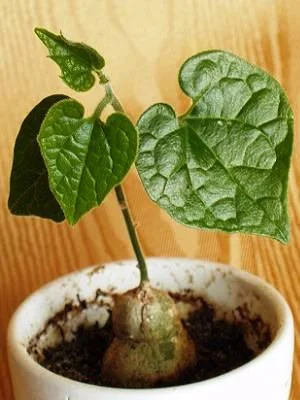
This member of the Icacinaceae family was given this name by Heinrich Gustav Adolf Engler in 1893. It is found in Somalia, Ethiopia, Kenya and Tanzania, growing in fine grit on hill-sides with little water and lots of sun. Never the less, it thrive with quite a lot of water and a rather rich soil. The caudex can grow to one and a half meter in diameter! The vines can grow to 15 meters. My plant add significantly to the caudex, but only in the late summer and autumn. Although I keep it dark and dry, it starts growing around first of March. Where my plant break dormant mid winter, when it is stored at 22C, it remains dormant at 12-15C. The genera name from Greek pyren; 'a stone fruit' and Greek akanthos; 'thorn' for the peglike protuberances from the inner surface of the fruit penetrating the cotyledons. The species name means 'mallow-leaved'. The flowers are unisexual (plants di- or monoecious) or bisexual. Bisexual flowers are usual found at the base of male flowers, the female in tiny clusters along the stems. With both sexes, the plant can self fertilize. I got seeds on a two year old cutting, which do form a perfect caudex. The young plants form sterile fruits. After it reached 40 centimetres in diameter, I try to stop the growth by growing it in a tiny pot, only containing less than quarter the amount of soil, compared to the caudex. That did little to stop the expansion. It still add ten centimetres to the diameter each year... Wild plant in Ethiopia by Otto Schmidt. This is about how big it can grow - in the wild. At first, extreme small female flowers occurs on the stems, at the base of leafstalks. They only produce sterile fruits, when no male flowers are present. In 2012, some new type of buds emerged: They were sitting in clusters, but still only female flowers, which are only 0,6 millimetres across. Male flowers on long inflorescences. Those are just as tiny, but sits on long inflorescence, up to seven centimetres long. These are bisexual flowers near the stem, at the base of male inflorescences. The fruits are sitting in clusters near the stem. Within the yellow fruits, the seeds are found, one in each fruit. The leaf glance produces a sugary sap.
Flower
Small! Green
Soil
Mix - Rich
Water
Medium - Maximum
Sun
Maximum
Similar plants