MERREMIA TUBEROSA
Author:
Alfred Barton Rendle, 1905.
Family:
CONVOLVULACEAE
Origin:
Bahamas, Belize, Brazil, Colombia, Costa Rica, Cuba, Dominican Republic, Ecuador, Guatemala, Guyana, Haiti, Honduras, Mexico, Nicaragua, Panama, Venezuela
Elevation:
Publisher:
Simões, A. R., & Staples. (2017). In: Bot. J. Linn. Soc. 183(4): 577.
Collection number:
placeholder
Thickness:
30 Centimetres
Height:
20 Meters
Propagate:
Seeds/Cuttings
CITES:
Synonyms:
Ipomoea tuberosa Linnaeus, 1753.
Distimake tuberosus, A.R.Simões & Staples.
Operculina tuberosa, Meisn. 1869.
Batatas tuberosa, Bojer, 1837.
Convolvulus dissectus Jacquin, 1767.
Show more (11)
Convolvulus gossypiifolius, Kunth, 1818.
Convolvulus kentrocaulos, Steud. ex Choisy, 1845.
Convolvulus macrocarpus, Spreng. 1825.
Convolvulus tuberosus, Spreng. 1825.
Ipomoea dissecta, Pursh, 1814.
Ipomoea nuda, Peter 1891.
Ipomoea sinuata, Ortega, 1798.
Merremia dissecta, Hallier f. 1893.
Merremia kentrocaulos, Rendle, 1905.
Operculina dissecta, House, 1906.
Operculina kentrocaulos, Hallier f.
This member of the Convolvulaceae family was given this name by Alfred Barton Rendle in 1905. It was originally found in the tropical America, but has now been spread to other tropical areas i.e. Hawaii, southern Florida, southern India and Ceylon.
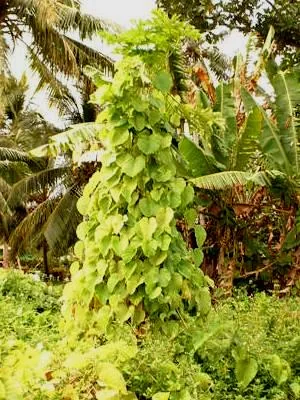
It grows in forests in a rich soil with lots of water and some sun. The caudex can reach 30 centimetres in diameter, the climbing vines will grow up to 20 meters, the flowers are bright yellow.
The genera name from a form of the Hebrew name Miriam, which was Latinised to Mary in later years. The species name means 'tuberous' for the roots. The dry fruits. "Wood Rose". Photo: Jean-Jacques Segalen.
Flower
Yellow
Soil
Mix
Water
Maximum
Sun
Medium
Similar plants