MASSONIA LONGIPES
Author:
John Gilbert Baker, 1897
Family:
HYACINTHACEAE
Origin:
Elevation:
Publisher:
W.H.Harvey & auct. suc. (eds.), Fl. Cap. 6: 411 (1897)
Collection number:
placeholder
Thickness:
6 Centimetres
Height:
3 (14) Centimetres
Propagate:
Seeds/Bulbs
CITES:
Synonyms:
–
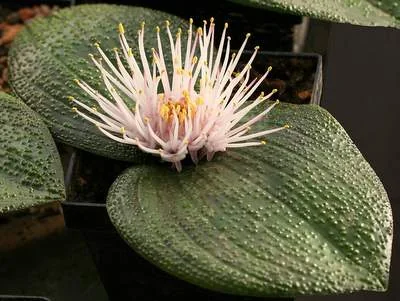
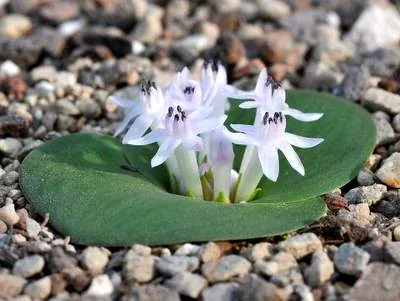
This member of the Hyacinthaceae family was described by John Gilbert Baker in 1897. It is found in southern South Africa, growing in grit or other well drained soil with some water and lots of sun. The bulb will grow to six centimetres in diameter, the leaves won't raise to more than three centimetres from the ground, but can get up to 14 centimetres long. The flowers are white to pale pink and are mainly pollinated by rodents.
The genera name after Francis Masson, 1741-1805, a British horticulturist, collecting in South Africa. The species name from Latin longus; 'long' and pes; 'foot' for the long peduncles. *) Accordantly to the latest taxonomic system; APG IV 2016, Hyacinthaceae is now part of the Asparagaceae. Habitat photo by Cameron McMaster, Africanplants.senckenberg.de.
Flower
White - Pale Pink
Soil
Grit - Mix
Water
Medium
Sun
Maximum