MANDEVILLA VELUTINA
Author:
Karl Moritz Schumann, 1895
Family:
APOCYNACEAE
Origin:
Elevation:
Publisher:
A. DC. (1844). In: Prodr. [A. DC.] 8: 458.
Collection number:
placeholder
Thickness:
12 Centimetres
Height:
80 Centimetres
Propagate:
Seeds/Cuttings
CITES:
Synonyms:
Echites velutinus Mart.& Stadelm. 1841.
Fernaldia pandurata, Woodson, 1932.
Mandevilla pohliana, A.H. Gentry, 1984.
Echites panduratus, A.DC.
Amblyanthera pandurata, Müll.Arg.
Show more (7)
Angadenia pandurata, Miers.
Echites pinguifolius, Standl.
Fernaldia brachypharynx, Woodson.
Fernaldia glabra, Lundell.
Fernaldia pandurata var. glabra, Molina.
Mandevilla potosina, Brandegee.
Urechites karwinskii, Müll.Arg.
This member of the Apocynaceae family was given this name by Karl Moritz Schumann in 1895.
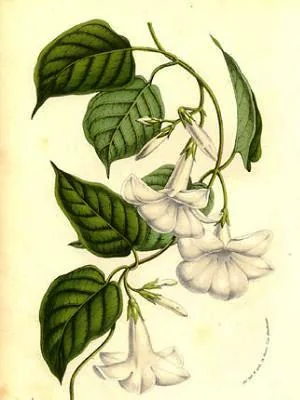
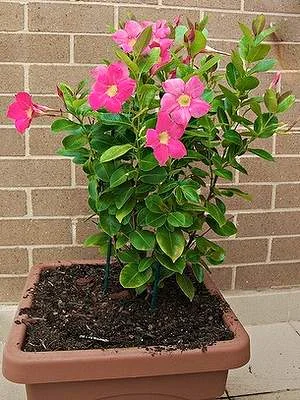
It is found in Argentina, Brazil, Bolivia, Costa Rica, El Salvador, Guatemala, Honduras, Mexico and Nicaragua, growing in a rather rich soil with quite some water and a lot of sun. The caudex can grow to twelve centimetres in diameter, the entire plant to 80 centimetres in height. The flowers are white and pink or pale pink. The extract of M. velutina underground systems is widely used against snake bites and as an anti-inflammatory agent. The genera is named after H. John Mandeville, 1773-1861, an English diplomat in Argentina.
The species name means 'velvet-like' like 'covered closely with short, soft hairs' for the leaves. The leaves on the vines by Laurent Quéno, Inaturalist.org. The leaves on the plant by luisfunez, Inaturalist.org.
Flower
White / Pink
Soil
Mix - Rich
Water
Medium - Maximum
Sun
Medium - Maximum