LECANOPTERIS CRUSTACEA
Author:
Edwin Bingham Copeland, 1931
Family:
POLYPODIACEAE
Origin:
Elevation:
Publisher:
Copel. (1931). In: Univ. Calif. Publ. Bot. 12: 406.
Collection number:
placeholder
Thickness:
3 Centimetres
Height:
35 Centimetres
Propagate:
Seeds/Rhizomes
CITES:
Synonyms:
Might be: Phymatodes crustacea, Richard Eric Holttum, 1955.
Myrmecophila crustacea, Tagawa
Polypodium crustaceum, Hoshiz.
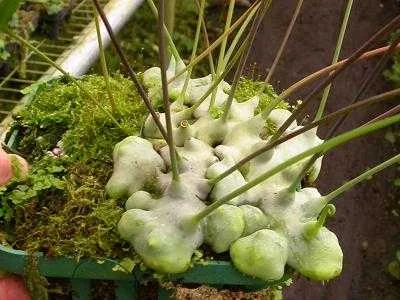
This member of the Polypodiaceae family was described by Edwin Bingham Copeland in 1931, and later by Richard Eric Holttum as Phymatodes crustacea. It is found Indonesia, Thailand and Malaysia. It grows in trees with some water and some sun. The hollow rhizomes will grow up to three centimetres in diameter, and the leaves will grow up to 35 centimetres.
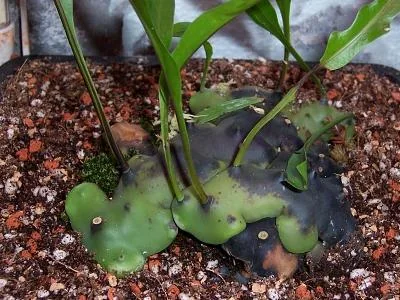
The genera name after some Lecan, but I fail to figure which one, or perhaps Greek lekane; 'bowl', and Latin pteris; 'fern'. The genera name Lecanopteris was introduced by Caspar Georg Reinwardt published in Flora 8, 1825. The species name from Latin crusta, meaning 'a hard (or brittle) shell or rind'. Seen on IPNI as member of the Pteridophyta family. The hollow rhizomes. Didi Turmudi, Indonesia. A young plant. Photo by Marc Altenloh.
Flower
No: Brown Spores
Soil
Bark, Moss
Water
Maximum
Sun
Minimum - Medium