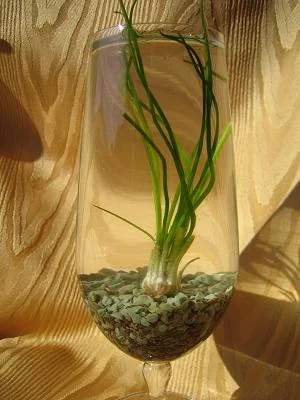
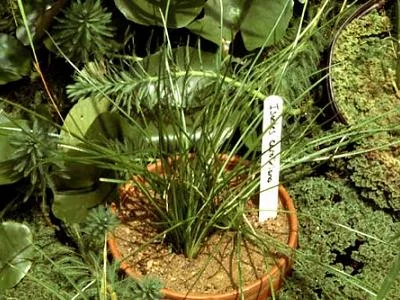
This member of the Isoetaceae family was given this name by Addison Brown in 1861. It is found in the southern Korea and probably in other parts of Asia, growing on swamps and in lakes with little nutrition, down to two meters debt and a pH around 7. The caudex can grow to three centimetre in diameter, the leaves to 30 centimetres length.
Isoetes japonica
and
I. coreana
are quite close. Both are submerged or amphibious.
I. coreana
produces megaspore with irregular, branching crested ornaments on surface while
I. japonica
produces megaspore that has evidently reticulate ornaments. The trilobed caudex of
Isoetes japonica
consists of two distinct structures, viz. Stem and Rhizophore, to which the leaves and roots are respectively attached; but owing to the stunted growth of the plant, all external morphological differentiation between the two organs has been completely lost.
The genera name means 'all the same year round'. The species name indicate its origin from Japan.
Also seen as member of the Juncaceae and Lycopodiaceae families.
Flower
No: Spores; White - Cream-Coloured
Soil
Sand
Water
Max
Sun
Medium