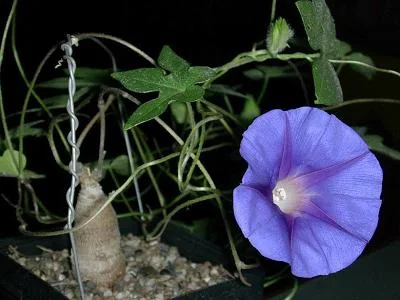

IPOMOEA WELWITSCHII
Author:
Wilhelm Vatke, 1894
Family:
CONVOLVULACEAE
Origin:
Angola, Botswana, Burundi, Democratic Republic of the Congo, Malawi, Namibia, Sudan, Tanzania, Zambia, Zimbabwe
Elevation:
Publisher:
Vatke ex Hallier fil. (1894). In: Bot. Jahrb. Syst. 18: 146.
Collection number:
placeholder
Thickness:
12 Centimetres
Height:
45 Centimetres
Propagate:
Seeds/?
CITES:
Synonyms:
Ipomoea inamoena, Robert Knud Friedrich Pilger, 1910.
Ipomoea aspericaulis, Baker. I pomoea hystrix, Hallier f.
Ipomoea multinervia, Verdc.
Ipomoea semisecta, Merxm.
This member of the Convolvulaceae family was described by Wilhelm Vatke in 1894. It is found in Angola, Botswana, Burundi, Malawi, Namibia, Sudan, Tanzania, Zambia, Zaïre and Zimbabwe, growing in a well drained soil with some water and some sun. The almost white caudex can grow to twelve centimetres or more, the vines will reach for 45 centimetres or more. The flowers are light pink. The generic name Ipomoea is derived from the Greek ἴψ, ἰπός; íps, ipós, meaning 'woodworm', and ὅμοιος; hómoios, meaning 'resembling'. It referring to their twining habit. The species name after Friedrich Martin Josef Welwitsch, 1806-1872, an Austrian explorer and botanist.
Flower
Light Pink
Soil
Mix
Water
Medium
Sun
Medium