IPOMOEA DIGITATA
Author:
Carl Linnaeus, 1759
Family:
CONVOLVULACEAE
Origin:
Elevation:
Publisher:
L. (1759). In: Syst. Ed. X. 924.
Collection number:
placeholder
Thickness:
10 Centimetres
Height:
4 Meters
Propagate:
Seeds/Cuttings
CITES:
Synonyms:
Ipomoea paniculata var. digitata Kuntze, 1891.
Quamoclit digitata, G. Don, 1838.
Convolvulus paniculatus, Kuntze, 1891.
Ipomoea paniculata, R. Br. 1810.
Ipomoea mauritiana Jacquin, 1797.
Show more (4)
Ipomoea paniculata var. digitata, Kuntze.
Ipomoea rubrocincta, Urb.
Ipomoea rubrocincta var. brachyloba, Urb.
Quamoclit digitata, G.Don.
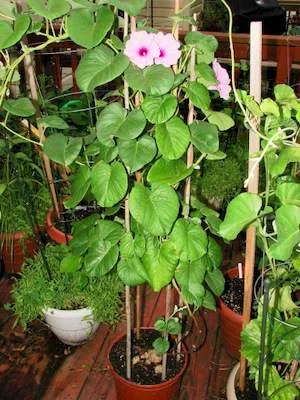
This member of the Convolvulaceae family was described by Carl Linnaeus in 1759. It is found in Dominican Republic and Haiti, growing in forests. It preferring a rich soil with quite some water and not that much sun. The tuberous roots will grow to ten centimetres in diameter, the vines to four meters in length. The flowers vary from pink to red. The plant can be reproduced both by seeds and cuttings, both of which form a caudex. It seems like it is the same plant as some of the Ipomoeas from Paraguay, Uruguay, and Argentina, which have been described later under other names. The generic name Ipomoea is derived from the Greek ἴψ, ἰπός; íps, ipós, meaning 'woodworm', and ὅμοιος; hómoios, meaning 'resembling'. It referring to their twining habit. The species name means 'with fingers'. From Specks, who sold it under the name Ipomoea mauritiana, Jacquin 1797.
Flower
Pink - Red
Soil
Rich
Water
Medium - Maximum
Sun
Medium