IPOMOEA BOLUSIANA
Author:
Hans Schinz, 1888
Family:
CONVOLVULACEAE
Origin:
Angola, Botswana, Democratic Republic of the Congo, Eswatini, Madagascar, Mozambique, Namibia, South Africa, Tanzania, Zambia, Zimbabwe
Elevation:
Publisher:
Schinz. (1888). In: Verh. Bot. Ver. Brandenb. 30: 271.
Collection number:
placeholder
Thickness:
20 Centimetres
Height:
3 Meters
Propagate:
Seeds/Cuttings
CITES:
Synonyms:
Ipomoea angustisecta Heinrich Gustav Adolf Engler, 1888.
Ipomoea mesenterioides Hallier, 1898.
Ipomoea praetermissa Rendle, 1901.
Ipomoea rubro-viridis Baker, 1886. (Ipomoea simplex Hook. 1846?).
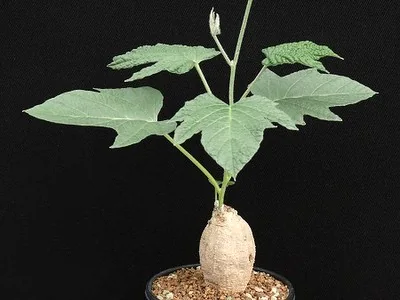
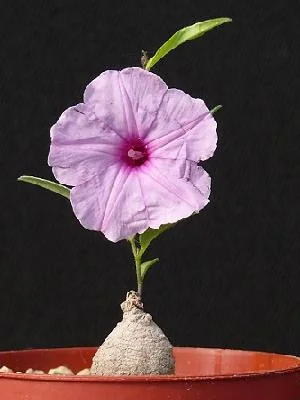
This member of the Convolvulaceae family was describes by Hans Schinz in 1888. It is found in southern Africa and Madagascar, growing in a well drained soil with some water and lots of sun. The caudex can grow to 20 centimetres in diameter, the creeping stems to three meters long. The flowers are pink, and the plant can be reproduced both by seeds and cuttings. The generic name Ipomoea is derived from the Greek ἴψ, ἰπός; íps, ipós, meaning 'woodworm', and ὅμοιος; hómoios, meaning 'resembling'. It referring to their twining habit. The species name is named after Harry Bolus, 1834-1911, a South African botanist, botanical artist, businessman and philanthropist. Except this one from Namibia.
Flower
Pink
Soil
Mix
Water
Medium
Sun
Maximum