HYDNOPHYTUM FORMICARUM
Author:
William Jack, 1823
Family:
RUBIACEAE
Origin:
Andaman Islands, Borneo, Cambodia, Indonesia, Java, Malaya, Maluku, Myanmar, New Guinea, Philippines, Sulawesi, Sumatra, Thailand, Vietnam
Elevation:
Publisher:
Trans. Linn. Soc. London 14: 124 (1823)
Collection number:
placeholder
Thickness:
25-30 Centimetres
Height:
40 Centimetres
Propagate:
Seeds/Cuttings
CITES:
Synonyms:
I find the genera a bit tricky, as there are so many synonyms. Like this species, which Powo.science.kew.org list with these:
Hydnophytum amboinense Becc.
Hydnophytum andamanense, Odoardo Beccari, 1885
Hydnophytum blumei Becc.
Hydnophytum borneense Becc.
Show more (14)
Hydnophytum coriaceum Becc.
Hydnophytum formicarum Kurz
Hydnophytum gaudichaudii Becc.
Hydnophytum inerme,Bremek. ex Holthuis & H.J.Lam
Hydnophytum intermedium Elmer
Hydnophytum leytense Merr.
Hydnophytum membranaceum Merr.
Hydnophytum mindorense Merr.
Hydnophytum montanum Blume
Hydnophytum nitidum Merr.
Hydnophytum orbiculatum Elmer
Hydnophytum selebicum Becc.
Hydnophytum sumatranum Becc.
Lasiostoma formicarum, Spreng.
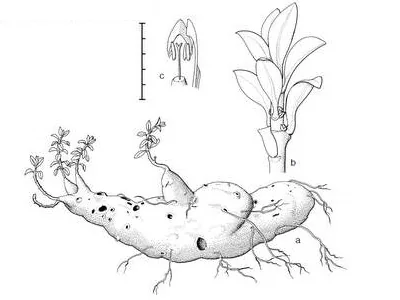
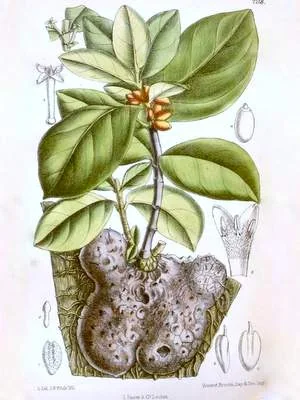
This member of the Rubiaceae family was described by William Jack in 1823. It's found in the jungles in Cambodia, Thailand, Vietnam and Malaysia. It is a epiphyte, and needs a lots of moist, but not much sun. It can be reproduced both by cuttings and seeds. The caudex will get op to 25 or even 30 centimetres, the branches 40 centimetres. The caudex is hollow, and forms a perfect nest for the ants, which protect the plant, and get a home and sweet sap in exchange. They might also bring back nutrition for the plant. It get a lots of white small flowers, and small red fruits. H. formicarum, have 6-12 pairs of veins in their leathery leaves, brownish and rough caudex with ridges, ant entrances only along the soil line, flowers 3-4 millimetres. It is considered by Dr C. R. Huxley to be an ochlospecies, which simply means a species that is so variable, it has not been possible to define population parameters. That seems obviously, when the plants from Cambodia was found. Often confused with H. moseleyanum which have 3-4 pairs of veins in their slightly succulent, silverish and smooth caudex without ridges, ant entrances spread all over the lover half of the caudex, flowers 4-5 millimetres. Sub-family: Rubioideae. Tibe:Psychotrieae. Sub-tribe: Hydnophytinae. In my experience, the seeds should be sown within a week after opening the fresh fruit.
The genera name after Greek hydnon meaning 'tuber' and phyton meaning 'plant', after the swollen branches. The species name indicate it is attracting ants. It needs righter high humidity. Hydnophyttnae KEY. Plants in Copenhagen from a new seed batch.
Flower
White
Soil
Peat - Epiphytic
Water
Maximum
Sun
Medium