HIPPEASTRUM AULICUM
Author:
William Herbert, 1837
Family:
AMARYLLIDACEAE
Origin:
Elevation:
Publisher:
Appendix: 31 (1821)
Collection number:
placeholder
Thickness:
12 Centimetres
Height:
30 (75) Centimetres
Propagate:
Seeds/Bulbs
CITES:
Synonyms:
Amaryllis aulica John Bellenden Ker Gawler. 1817.
Omphalissa aulica, Richard Anthony Salisbury, 1866.
Amaryllis aulica var. platypetala, Lindl.
Amaryllis heuseriana, Ravenna
Amaryllis heuseriana f. campanulata, Ravenna.
Show more (10)
Amaryllis robusta, Otto & A.Dietr.
Amaryllis rougieri, Carrière.
Aulica latifolia, Raf.
Aulica platypetala, Raf.
Aulica striata, Raf.
Hippeastrum aulicum var. platypetalum, Herb.
Hippeastrum aulicum f. robustum, Voss.
Hippeastrum heuserianum, H.Karst.
Hippeastrum tweedieanum, Herb.
Trisacarpis rubra, Raf.
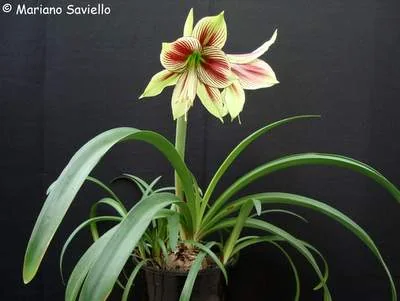
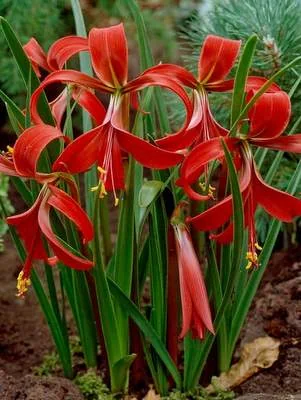
This member of the Amaryllidaceae family was given this name by William Herbert in 1837. It is found in the forests of Brazil and Paraguay, growing as an epiphytic, but can be grown in a well drained soil like orchid mix with quite some water and little to some sun. The bulb can grow to twelve centimetres in diameter, the leaves to 30 centimetres in height. The flowers are scarlet. Surprisingly, this is actually an epiphytic, usually found on bare rocks and large trees.
The name Hippeastrum is a combination of the Greek word hippeus 'horse' and astron 'star', which means 'horseman's star' or 'knight's star', as the flowers have a star-like shape. The species name meaning 'princely'. This is an evergreen species. It usually blooms in autumn to winter.
Flower
Scarlet
Soil
Epiphytic - Mix
Water
Maximum
Sun
Minimum - Medium