HAEMANTHUS ALBIFLOS
Author:
Nicolaus Joseph von Jacquin, 1797
Family:
AMARYLLIDACEAE
Origin:
Elevation:
Publisher:
Pl. Hort. Schoenbr. 1: 31 (1797)
Collection number:
placeholder
Thickness:
8 Centimetres
Height:
25 Centimetres
Propagate:
Seeds/Offset Bulbs
CITES:
Synonyms:
Hamanthus mackenii Baker.
Haemanthus albomaculatus Baker.
Haemanthus virescens var. albiflos, Herbert, 1837.
Diacles ciliaris, Salisb.
Haemanthus intermedius, M.Roem.
Show more (1)
Haemanthus leucanthus, Miq.
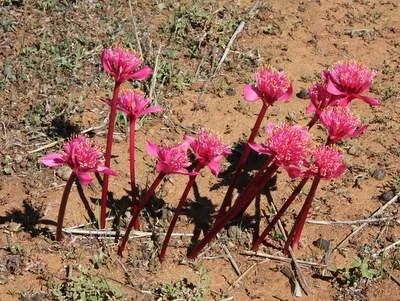
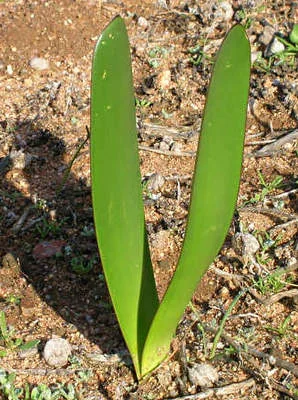
This member of the Amaryllidaceae family was described by Nicolaus Joseph von Jacquin in 1797. It is found on the south-eastern coast of South Africa, growing in well-drained soil with some water and little sun. It have broad leaves which will get 25 centimetres long, and an bulb which can grow to eight centimetres in diameter. The flower is white, and the plant can both be reproduced by seeds, from the reed fruits, and by offsets. It is actually evergreen like H. deformis and H. pauculifolius.
The name Haemanthus is derived from the Greek haima meaning 'blood' and anthos meaning 'flower' - a reference to the red flowers of most species. Albiflos referring to the white flowers of this particular species. Wild ones from Port Edward, South Africa.
Flower
White
Soil
Mix
Water
Medium
Sun
Minimum - Medium