EUPHORBIA TUBEROSA
Author:
Carl Linnaeus, 1753
Family:
EUPHORBIACEAE
Origin:
Elevation:
Publisher:
Sp. Pl.: 456 (1753)
Collection number:
placeholder
Thickness:
2-4 Centimetres
Height:
15 Centimetres
Propagate:
Seeds/Cuttings
CITES:
Synonyms:
Might be: Tithymalus tuberosus, Hill, 1768
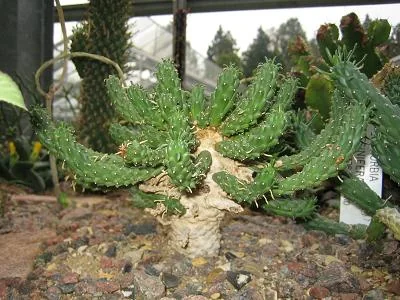
This member of the Euphorbiaceae family was described by Carl Linnaeus in 1753, and later by Hill in 1768 as Tithymalus tuberosus. It is found on the Cape, South Africa, growing in a well drained soil with some water and some sun. The swollen stems can grow from two to four centimetres in diameter, the whole plant up to fifteen centimetres height. The flowers are greenish yellow.
The genera name; Euphorbia dates back to the first century BC, where King Juba II of Mauritania used it in a reference to his doctor, Euphorbos, and that name was kept as a generic name by Carl von Linnaeus. The species name means 'tuberous'. This might be a winter-grower. Strangely enough, IPNI says: Distribution: Mexico (Northern America), and author: Joseph Nelson Rose 1891. I asked them, and got this explanation: "There are 2 Euphorbia tuberosa species: Linnaean name (1753) from S. Africa; Rosean name (1891) from Mexico (a later homonym)."
Flower
Greenish Yellow
Soil
Mix
Water
Medium
Sun
Medium