EUPHORBIA MILII
Author:
Charles R.A: Des Moulins, 1826
Family:
EUPHORBIACEAE
Origin:
Elevation:
Publisher:
Bull. Hist. Nat. Soc. Linn. Bordeaux 1: 27 (1826)
Collection number:
placeholder
Thickness:
15 Centimetres
Height:
180 Centimetres
Propagate:
Seed/Cuttings
CITES:
Synonyms:
Euphorbia bojeri Hooker, 1836.
Euphorbia bojeri var. mucronulata Ram. Goyena, 1909.
Euphorbia breonii Noissette, 1836.
Euphorbia splendens Bojer ex Hooker, 1829.
Euphorbia splendens subsp. bojeri (Hook.) Denis, 1921.
Show more (3)
Sterigmanthe bojeri Klotsch & Garcke, 1859.
Tumalis bojeri (Hook.) Raf. 1838.
More variations below.
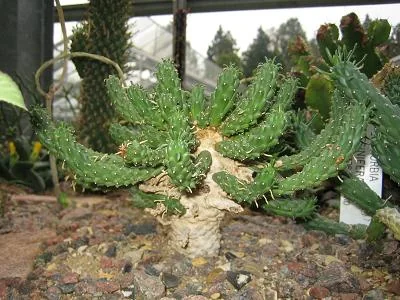
This member of the Euphorbiaceae family was given this name by Charles Robert Alexandre Des Moulins in 1826. It is found on Madagascar from the Fort Dauphin area; 20 km south of Betroka; mountains near Ihosy, between Antsirabe and Fianarantsoa; north of Antananarivo, near Maevatanana; on the High Plateau near Imerina; Zombitse forest (Sakaraha) and at Le Table mountain near Tulear. It is found in bush and forests, growing in a well drained granite gravel with some water and some sun. The caudex can grow to fifteen centimetres in diameter, the entire plant to 180 centimetres in height. The flowers are from white over pink to red. This variation; tenuispina was given this name by Werner Rauh and Alfred Razafindratsira in 1991. Beside from this, there are several variations and forma: Euphorbia milii var. bevilanensis Ursch & Leandri 1946. Euphorbia milii v ar. bosseri Rauh 1970. Euphorbia milii var. hislopii Leandri 1954. Euphorbia milii var. imperatae Ursch & Leandri 1955. Euphorbia milii var. longifolia Rauh 1967. Euphorbia milii fo. lutea Leandri 1952. Euphorbia milii fo. platyacantha Leandri 1952. Euphorbia milii var. roseana Marnier-Lapostolle 1962. Euphorbia milii var. splendens Ursch & Leandri 1954. Euphorbia milii var. tananarive Leandri 1946. Euphorbia milii var. tulearensis Ursch & Leandri 1954. Euphorbia milii var. vulcani Leandri 1946. Several of these, including E. m. var. tenuispina are believed to be extinct in the wild.
The genera name; Euphorbia dates back to the first century BC, where King Juba II of Mauritania used it in a reference to his doctor, Euphorbos, and that name was kept as a generic name by Carl von Linnaeus. The species name is named in honour of M. le baron Milius, the Governor of then Ile Bourbon (Mauritius) and Governor of Réunion.
Flower
White - Pink - Red
Soil
Mix
Water
Medium
Sun
Medium