EUPHORBIA HYPERICIFOLIA
Author:
Carl Linnaeus, 1753
Family:
EUPHORBIACEAE
Origin:
Argentina, Bahamas, Belize, Bolivia, Brazil, Chile, Colombia, Costa Rica, Cuba, Dominican Republic, Ecuador, El Salvador, French Guiana, Georgia, Guatemala, Guyana, Haiti, Honduras, Leeward Islands, Netherlands Antilles, Nicaragua, Panama, Paraguay, Peru, Puerto Rico, South Carolina, Southwest Caribbean, Suriname, Trinidad and Tobago, Turks and Caicos Islands, United States, Uruguay, Venezuela
Elevation:
Publisher:
Sp. Pl.: 454 (1753)
Collection number:
placeholder
Thickness:
6 Centimetres
Height:
60 Centimetres
Propagate:
Seeds / Cuttings
CITES:
Synonyms:
Anisophyllum hypericifolium, Haw. 1812.
Chamaesyce hypericifolia, Millsp. 1909.
Chamaesyce boliviana, Croizat 1946.
Chamaesyce glomerifera, Millsp. 1913.
Ditrita obliqua, Raf. 1838.
Show more (6)
Euphorbia boliviana, Rusby 1907.
Euphorbia cuspidata, Bertol. 1844.
Euphorbia glomerifera, Wheeler 1939
Euphorbia indica, Lam 1786.
Euphorbia lasiocarpa, Klotzsch 1843.
Euphorbia papilligera, Boiss. 1860.
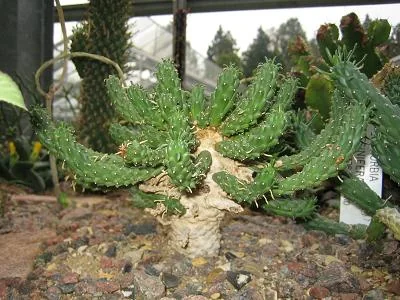
This member of the Euphorbia family was given this name by Carl Linnaeus in 1753. It is found in southern North America and South America - and introduced in many other areas. It is growing in a well drained soil with some water and some to lots of sun. The caudex can grow to six centimetres in diameter, the entire plant to 60 centimetres in height. The flowers are white and numerous.
The genera name; Euphorbia dates back to the first century BC, where King Juba II of Mauritania used it in a reference to his doctor, Euphorbos, and that name was kept as a generic name by Carl von Linnaeus. The species name from the leaves resembles to the genera Hypericum.
Flower
White
Soil
Mix
Water
Medium
Sun
Medium - Maximum