COMMIPHORA WIGHTII
Author:
Madan Mal Bhandari, 1965
Family:
BURSERACEAE
Origin:
Elevation:
Publisher:
Bhandari. (1965). In: Bull. Bot. Surv. Ind. 6: 327.
Collection number:
placeholder
Thickness:
30 Centimetres
Height:
2-4 Metres
Propagate:
Seeds/Cuttings
CITES:
Synonyms:
Balsamodendron wightii, George Arnott Walker Arnott. 1839.
Commiphora mukul, Engler 1883.
Commiphora roxburghii, Engler, 1896.
Balsamodendrum mukul, Hooker, 1849.
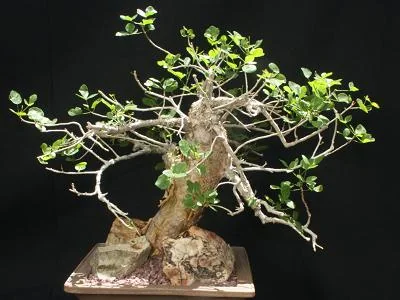
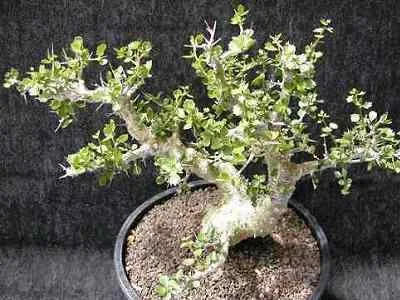
This member of the Burseraceae family was given this name by Madan Mal Bhandari in 1965. It is mainly found in India, Oman and Pakistan, but should be found all the way from northern Africa to central Asia. It is growing in a poor and well drained soil with little to some water and some to lots of sun. The bush can grow to two metres or even four with a stem up to 30 centimetres in diameter. The flowers are from red to pink.
The genera name from Greek kommi; 'gum' and Greek - phoros; 'carrying' for the balsam-like scented resin. The species name after Robert Wight, 1796 – 1872, a Scottish surgeon in the East India Company, whose professional career was spent entirely in southern India, where his greatest achievements were in botany – as an economic botanist and leading taxonomist in south India.
This species is dimorphic; one having bisexual and male flowers, and the other having female flowers with staminodes.
Flower
Red - Pink
Soil
Mix
Water
Medium
Sun
Medium - Maximum