CISSUS SICYOIDES
Author:
Carl Linnaeus, 1759
Family:
VITACEAE
Origin:
Belize, Bolivia, Colombia, Ecuador, El Salvador, Guatemala, Honduras, Mexico, Panama, Peru, United States, Venezuela
Elevation:
Publisher:
C. V. Morton & Standl. (1937). In: Publ. Field Mus. Nat. Hist., Chicago, Bot. Ser. 18: 653.
Collection number:
placeholder
Thickness:
15 Centimetres
Height:
6-10 Metres
Propagate:
Seeds/Cuttings
CITES:
Synonyms:
Vitis vitiginea, W.Theob. var. sicyodes Kuntze, 1891.
Cissus canescens Lam. 1792.
Cissus compressicaulis Ruiz & Pav. 1798.
Cissus umbrosa Kunth, 1822.
Cissus elliptica Schltdl. & Cham. 1830.
Show more (14)
Cissus obtusata Benth.1844.
Irsiola sicyoides Raf. 1838.
Vitis sicyoides Morales, 1866.
Cissus brevipes C.V. Morton & Standl.1937.
Cissus verticillata Nicolson & C.E. Jarvis, 1984.
And perhaps:
Cissus javana, DC.
Cissus marmorea, G.Don
Cissus sessilis, Amshoff.
Vitis bracteata, Noronha
Vitis costata, Wall.
Vitis discolor, Dalzell
Vitis diversifolia, Wall.
Vitis inaequalis, Wall.
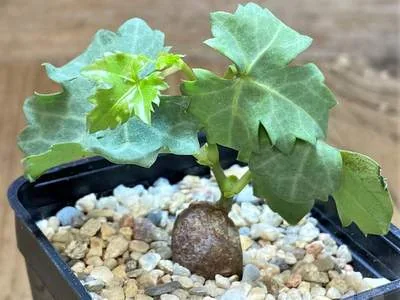
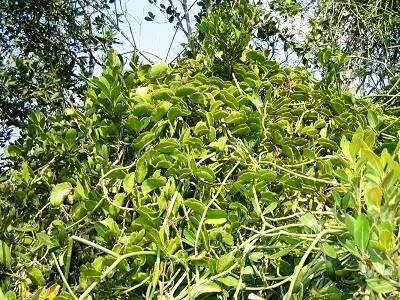
This member of the Vitaceae family was given this name by Carl Linnaeus in 1759. It is found in Belize, Bolivia, Colombia, Ecuador, El Salvador, Guatemala, Honduras, Mexico, Panama, Peru, USA and Venezuela. If it is a synonym of Cissus discolor, it is a good part of Asia!). It is growing in a well drained soil with quite some water and some to lots of sun. The caudex can grow to fifteen centimetres in diameter, the vines can reach six to ten metres in length. The flowers are from white over greenish to yellow. The generic name is derived from the Greek word κισσος kissos, meaning 'ivy'. The species name means 'looking like Sicyos'.
Flower
Greenish White - White - Yellow
Soil
Mix
Water
Medium
Sun
Medium - Maximum