CALIBANUS HOOKERI
Author:
William Trelease, 1911
Family:
NOLINACEAE
Origin:
Elevation:
Publisher:
J. Bot. 10: 327 (1872)
Collection number:
placeholder
Thickness:
1 Meter
Height:
50 Centimetres
Propagate:
Seeds
CITES:
Synonyms:
Nolina hookeri Rowley, 1990,
Dasylirion hookeri Lemaire, 1859.
Beaucarnea hookeri Baker, 1872.
Calibanus caespitosus Rose, 1906.
Dasylirion caespitosum, Scheidw.
Show more (3)
Dasylirion flexile, K.Koch
Dasylirion hartwegianum, Hook.
Is actually now back to; Beaucarnea hookeri Baker, 1872.
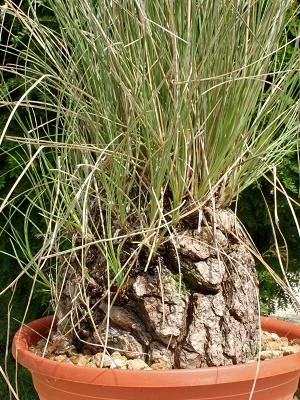
This member of the Nolinaceae family was first described by Sir William Hooker as Dasylirion hartwegianum (by mistake). Then by Lemaire in 1859, as Dasylirion hookeri. In 1911 William Trelease moved it to the Calibanus genesis. Its found in Hidalgo, San Luis Potosí, Mexico, where it grows in grit and enjoys quite some water in the short growing-season and lots of sun. The caudex can grow to one meter in diameter, but the grass-like leaves will only get half a meter long. The clusters of flowers are pink, and it can not be reproduced by cuttings of the caudex (or leafs). I found my first small one in Llandilo, Australia in 2002. It is dioecious, I don't know what I got.
The name Calibanus is after Shakespeare's monster Caliban. The species after Joseph Dalton Hooker, 1817-1911, a English botanist. DNA study by Vanessa Rojas-Piña, Mark E. Olson, Leonardo O. Alvarado-Cárdenas & Luis E. Eguiarte show Calibanus is nested within the Beaucarnea. Maybe it was re-named by G.D. Rowley in 1990, as Nolina hookeri. Despite of its differences in seeds. DNA study proved it wrong. *) Accordantly to the latest taxonomic system; APG IV 2016, Nolinaceae is now part of the Asparagaceae. The male flowers.
Flower
Pink
Soil
Grit
Water
Medium
Sun
Medium
Similar plants