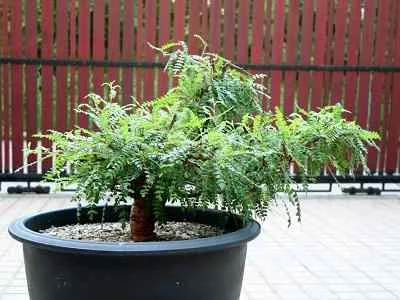
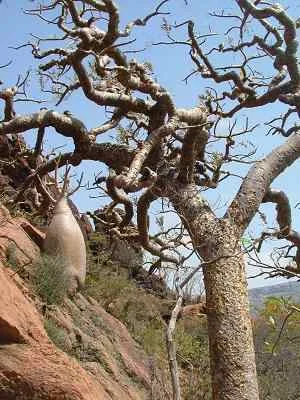
This member of the Burseraceae family was described by Frank Nigel Hepper in 1971. It is found on the Yemen island; Socotra, growing in grit or other well drained soil with little to some water and lots of sun. The stem can grow up to 30 centimetres in diameter and 2,5 meters high. The flowers are brownish red. It is possible that Boswellia nana is a natural hybrid between B. socotrana and another Boswellia species (though which other species is, as yet, unknown). Some evidence for this is found in a solitary Boswellia tree discovered growing at the bottom of limestone cliffs at Hamadero; it displays some characteristics of both B. nana and B. socotrana. Furthermore, this tree is growing in an area that lies ecologically in between the habitats of both species, sharing certain qualities. However, B. nana was thought (by botanists Mats Thulin and Abdul Nasser Al-Gifri, in 1998) to be a smaller form of Boswellia popoviana.
The genera name honours the Scottish botanist John Boswell, 1710 - 1780. The species name means 'dwarf'.
Flower
Brownish Red
Soil
Grit - Mix
Water
Minimum - Medium
Sun
Maximum