ANTHORRHIZA AREOLATA
Author:
C.R. Huxley & M.H.P. Jebb, 1991
Family:
RUBIACEAE
Origin:
Elevation:
Publisher:
Blumea 36: 33 (1991)
Collection number:
placeholder
Thickness:
25 Centimetres
Height:
50 Centimetres
Propagate:
Seeds
CITES:
Synonyms:
–
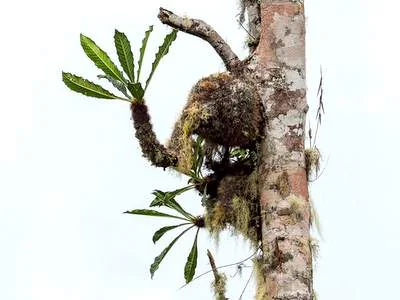
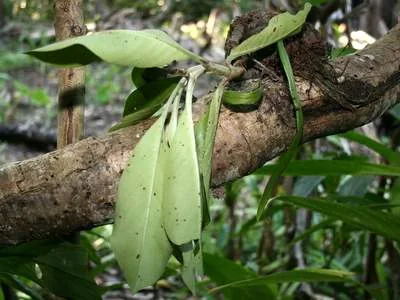
This plant was found at Sewa Bay, Normanby Island, D'Entrecasteaux Islands, Milne Bay Province, Papua New Guinea. The unripe fruit by Derrick Rowe. The caudex with entrance by Derrick Rowe. The inflorescense by Derrick Rowe. The flower by Derrick Rowe. C.R. Huxley & M.H.P. Jebb, 1991 RUBIACEAE Papua New Guinea No; Epiphytic - Moss Maximum Minimum - Medium 25 Centimetres 50 Centimetres White Seeds Ant plant - This epiphytic member of the Rubiaceae family was described by Camilla Rose Huxley and Matthew H. P. Jebb in 1991. It is found in the jungles of Papua New Guinea. The hollow and rough caudex will grow to 25 centimetres in diameter, the branches reach 50 centimetres in length. The flowers are white on this ant plant, while the fruits are orange-red. The genera name from Green anthos; 'flower' and rhiza; 'root' for the root-derived spines around the flowers. The specific name describes the roughened, areolate surface of the tuber, which readily distinguishes this species. Key to the Species of Anthorrhiza. 1a. Spines present on stem…................................. 2. 1b. Spines absent on stem or very few…............... 7. 2a. Spines largely, but not exclusively confined to the inflorescence forming a cushion in the leaf axils. Leaves 4-10cm wide…...................................... 3. 2b. Spines scattered on stem. Leaves usually less than 4cm wide…................................................. 4. 3a. Inflorescence with fleshy ridges separating flower-producing tissue. Spines straight, usually dense on tuber. Corolla lobes greenish white. Anthers cream................... Anthorrhiza echinella. 3b. Inflorescence without ridges of tissue. Spines gently curved, usually sparse on tuber. Corolla white. Anthers bl........ Anthorrhiza recurvispina. 4a. Lamina less than 8cm long, stipules persistent, rounded…......................... Anthorrhiza stevensii. 4b. Lamina more than 10cm long, stipules caducous (easily shed), triangular or rounded…............... 5. 5a. Stem dorsiventral, (flattened + distinct upper and lower surfaces) more spines on upper side, spines light brown to blackish. Leaf margin crinkled. Corolla blue…..... Anthorrhiza caerulea. Camilla Rose Huxley & Matthew H. P. Jebb in 1991. Papau New Guinea, 15 centimetres in diameter. One or rarely two, unbranded stems. Pale blue/turquoise flowers. Fruits orange. 5b. Stem radially symmetrical, rarely dorsiventral. Spines golden brown. Leaf margin flat. Corolla white to greenish white........................................ 6. 6a. Inflorescence bracts leathery, splitting regularly, apiculate, persistent. Petals with long slender lobe tips….............. Anthorrhiza chrysacantha. 6b. Inflorescence bracts papery, tearing irregularly, not apiculate, caducous (easily shed.) Petals acute-rounded….................. Anthorrhiza camilla. 7a. Inflorescence covered by leathery and papery bracts. Fruit with 4-8 pyrenes........................... Anthorrhiza bracteosa. 7b. Inflorescence sunken or covered by a dense cushion of bract hairs. Fruit with 2 pyrenes…..... 8. 8a. Tuber surface smooth. Leaves to 17x7cm. Inflorescence narrowly cordate in outline…............................. Anthorrhiza mitis. Camilla Rose Huxley & Matthew H. P. Jebb in 1991. Papau New Guinea. Diameter 30 centimetres, height of caudex 26 centimetres Total?. Several unbranched stems. Flowers whit, fruits orange-red. 8b. Tuber surface areolate (roughened by areolae). Leaves to 11x4cm. Inflorescence arch-shaped in outline....... Anthorrhiza areolata. A key to the genera of the HYDNOPHYTTNAE is found on the Myrmecodia alata page. The leaves by Derrick Rowe.
Flower
White
Soil
No; Epiphytic - Moss
Water
Maximum
Sun
Minimum - Medium