AMORPHOPHALLUS TITANUM
Author:
Odoardo Beccari, 1879
Family:
ARACEAE
Origin:
Elevation:
Publisher:
Bull. Soc. Tosc. Ortic. 4(2): 46 (1879)
Collection number:
placeholder
Thickness:
100 Centimetres
Height:
6 Metres
Propagate:
Seeds/Leaf Cuttings
CITES:
Synonyms:
Conophallus titanum, Odoardo Beccari, 1878.
Amorphophallus selebicus Nakai, 1948.
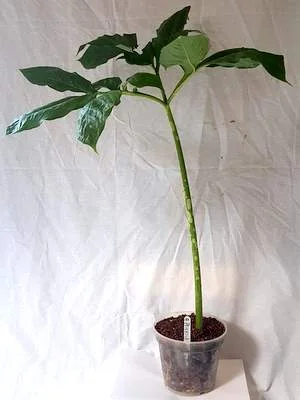
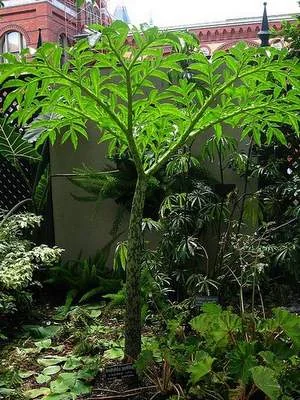
This member of the Araceae family was given this name by Odoardo Beccari in 1879. It is found in the edges of the Sumatran jungle in Indonesia, growing in a rich soil with plenty of water and little to some sun. The bulb can weight up to 50 or even 100 kilos, measuring up to one meter in diameter. The single leaf can reach a height of six metres. When the plant mature - bulb is said to have to exceed 50 centimetres - it first grow its huge inflorescent, which can reach three metres in height. When it dies back, the leaf emerges, reaching up to six metres in height and five across. And it still have time for four months or dormancy!
The genera name from ancient Greek amorphos, 'without form, misshapen' and phallos, 'penis', referring to the shape of the prominent spadix. The species name; titan means 'giant' after the ancient Greek goods; Titans. It is - along with some others: "The largest flower in the world". Actually, it is the largest unbranched inflorescence in the world. The largest single flower is found on Rafflesia arnoldii, while the largest branched inflorescence belongs to the Talipot palm, Corypha umbraculifera. Anyway; this species share the distinct odour with related species: Rotting meat! Might not be considered a caudiciforms: The giant bulb does not appreciate to be exposed, and the roots emerges on its top. The leaf seen from underneath. The massive stalk for it. Up to six metres high. First year: One meter bud. No sent yet. Adding 7-10 centimetres a day! Seen from above. Deep in the funnel, the female flowers are revealed first. A massive odour fill the house for nine hours only. After a week, the unfertilized inflorescence shrinks. The fruits. In the wild, the plant can't self-pollinate: The female flowers occurs first. However, the pollen can be frozen down and used on the next inflorescence. These have been frozen to -196C, and they are alive.
Flower
Green / Maroon
Soil
Rich Peat
Water
Maximum
Sun
Minimum - Medium